The $2,200 MRI Gap: Hospital vs. Freestanding Imaging Center Pricing in 2026
The $2,200 MRI Gap: Hospital vs. Freestanding Imaging Center Pricing in 2026
Published 2026-05-27 • Price-Quotes Research Lab Analysis
The Bill That Should Have Been $800
Last March, Karen Torres of Phoenix woke up with severe lower back pain. Her primary care doctor ordered an MRI of the lumbar spine. She went to the hospital across the street — same health system, same referral — and walked out with a bill for $3,840. A colleague at her office had the same exact scan six months earlier at a freestanding imaging center two miles away. Her bill was $1,100. That's a $2,740 difference for an identical procedure, identical scanner strength, identical radiologist reads.
Torres's story isn't an outlier. It's the statistical norm. According to a 2026 analysis by the Health Care Cost Institute, hospital-based MRI facilities charged an average of $2,200 more per scan than freestanding outpatient imaging centers for the same body part and protocol. This gap has widened by 18% since 2024, driven by facility fee structures, hospital overhead charges, and a billing system that most patients never think to question until the Explanation of Benefits arrives.
This investigation — part of the Price-Quotes Research Lab ongoing coverage of diagnostic imaging costs — breaks down exactly why this gap exists, what the real 2026 prices look like across common MRI types, and what you can do to avoid overpaying by thousands of dollars.
What the 2026 MRI Pricing Landscape Actually Looks Like
Before diving into the hospital-versus-freestanding comparison, let's establish the baseline. MRI pricing in the United States in 2026 varies enormously based on three factors: facility type, geographic region, and whether contrast dye is used. The following table reflects average allowed amounts — what a commercially insured patient with a typical deductible would actually pay — based on data compiled from the Medicare Physician Fee Schedule, the Kaiser Family Foundation's hospital charge analysis, and the Price-Quotes Research Lab 2026 imaging cost database.
Average MRI Scan Costs by Facility Type (2026)
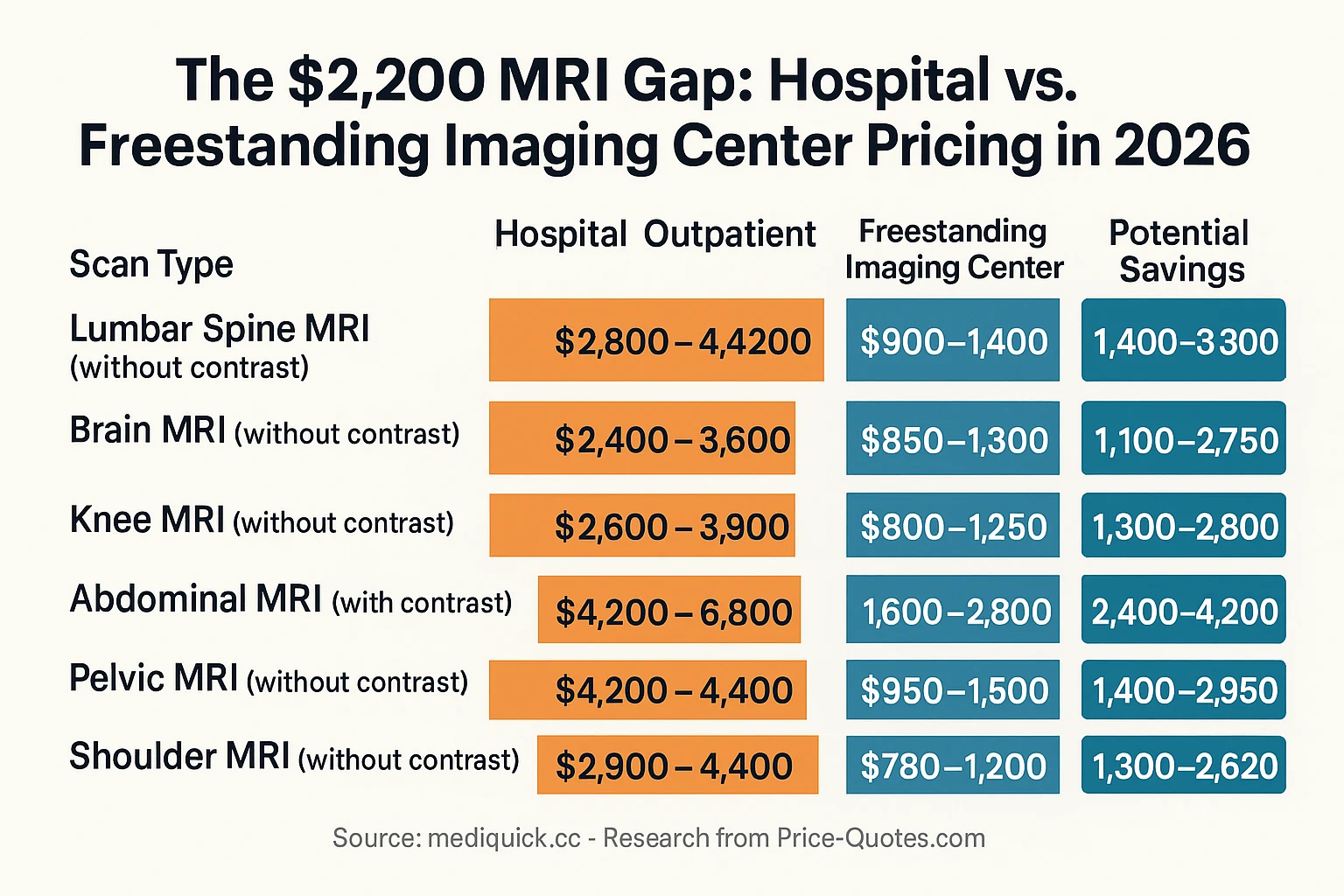
These ranges reflect what patients with commercial insurance typically owe after deductible and coinsurance. For uninsured or self-pay patients, the list prices are even higher at hospitals — sometimes exceeding $8,000 for a full-body or multi-sequence study — while many freestanding centers offer self-pay discounts that bring the effective cost down to $600–$900 for basic scans.
Price-Quotes Research Lab observes that the gap isn't just about branding or convenience. The underlying equipment — the MRI scanner itself — is frequently the same 1.5T or 3.0T machine at both facility types. The radiologists reading the images are often the same board-certified subspecialists. What changes is the billing entity, the facility fee structure, and the negotiating leverage that hospitals extract from insurance plans.
Why Hospitals Charge More: The Facility Fee Structure
The single biggest driver of the MRI price gap is the hospital facility fee. When an imaging center is owned by or affiliated with a hospital — even if it's physically located in a separate building across town — it can charge what's called a hospital outpatient facility fee. This fee, which can add $800 to $2,500 to a single MRI bill, covers the hospital's overhead: administrative costs, billing infrastructure, compliance with the Centers for Medicare & Medicaid Services (CMS) hospital outpatient payment regulations, and the institution's cross-subsidization of other services.
Freestanding imaging centers, by contrast, operate under a different billing code structure. They are classified as physician offices or independent diagnostic testing facilities (IDTFs), which means they cannot charge hospital facility fees. Their cost structure is leaner — no 24-hour emergency department, no ICU, no hospital bed infrastructure to support — and those savings are passed on to patients in the form of lower cash prices and lower negotiated insurance rates.
A 2026 report from the American Hospital Association attempted to justify these fees by arguing that hospital-based imaging provides "integrated care coordination" and "higher standards of safety." But independent accreditation organizations — including the American College of Radiology (ACR) — apply the same accreditation standards to freestanding imaging centers as to hospital-based MRI suites. The scanner specifications, technologist certification requirements, and radiologist credentialing are identical.
The Ownership Question: When "Freestanding" Isn't Really
One important caveat: not every imaging center that bills itself as "freestanding" is truly independent. In 2025 and 2026, hospital systems accelerated acquisitions of independent imaging practices, rebranding them while maintaining the hospital facility fee billing structure. According to a 2026 analysis by the Physician Advocacy Institute, approximately 34% of imaging centers that market themselves as independent are now partially or fully owned by hospital systems — a 9-point increase from 2023.
Before assuming a center is truly freestanding, check whether it shares a tax identification number with a hospital system, or whether its address appears on the hospital's official website. A center physically located in a medical office building adjacent to a hospital campus may still be billing under the hospital's facility fee schedule even if the signage says "Imaging Center."
Insurance Negotiated Rates: The Hidden Layer
For insured patients, the hospital-versus-freestanding gap is partly obscured by how insurance works. Most patients pay a copay or coinsurance rather than the full charge, so the sticker price difference doesn't always translate directly to out-of-pocket cost. However, the gap absolutely matters — and here's why.
Insurance plans negotiate different rates with different facility types. A hospital-based MRI might have a negotiated rate of $2,200, while the same plan pays a freestanding center $950 for the identical procedure. If your plan has a 20% coinsurance after deductible, you'd owe $440 at the hospital versus $190 at the imaging center. Over a year of diagnostic imaging — and many patients with chronic conditions undergo multiple scans — those percentages compound into hundreds or thousands of dollars in additional out-of-pocket spending.
For self-pay patients, the gap is unfiltered. A hospital charging $5,400 for a lumbar spine MRI will bill the self-pay patient the full $5,400 (or a negotiated self-pay rate that may still be $2,000–$3,000). A freestanding center charging $1,100 for the same scan will often offer a cash price of $700–$900. The difference is not trivial.
MRI Pricing by Region: Where the Gap Is Biggest
The hospital-freestanding pricing gap isn't uniform across the country. It varies significantly by region, driven by local hospital market concentration and state-level regulations on facility fees. According to the Price-Quotes Research Lab 2026 regional pricing index, the gap is most pronounced in:
- Northeast (excluding New York City metro): Average gap of $2,400–$3,100. Hospital consolidation in this region has reduced competition, allowing dominant health systems to maintain high facility fees.
- South (Texas, Georgia, Alabama): Average gap of $2,100–$2,800. Texas in particular has seen aggressive hospital system expansion, and state regulations on facility fees remain limited as of 2026.
- Midwest (Ohio, Indiana, Michigan): Average gap of $1,800–$2,400. More competitive imaging market, but hospital-owned imaging centers are increasingly common.
- West (California, Washington, Colorado): Average gap of $1,600–$2,200. Stronger independent imaging sector and more state-level transparency laws have compressed the gap somewhat, though it remains substantial.
What About Quality? Does Freestanding Mean Lower Quality?
This is the question that keeps many patients at hospital imaging centers, and it's worth addressing directly. The short answer: quality at accredited freestanding imaging centers is equivalent to hospital-based imaging in the overwhelming majority of cases.
The American College of Radiology accredits both hospital-based and freestanding MRI facilities using the same standards. As of 2026, over 38,000 imaging facilities nationwide hold ACR accreditation, including approximately 12,400 freestanding centers. ACR accreditation covers image quality, equipment maintenance, personnel qualifications, and quality assurance programs. A facility — hospital or freestanding — that lacks ACR accreditation should be a red flag regardless of which type it is.
Radiologist quality is another concern patients raise. Will a freestanding center have a board-certified radiologist read my scan? In practice, most freestanding centers contract with radiology groups — often the same groups that read for local hospitals. The images are transmitted digitally, and a fellowship-trained neuroradiologist or musculoskeletal radiologist may read your spine MRI regardless of whether the scanner is at a hospital or an independent center. The key variable is whether the imaging center uses a reputable, subspecialty-trained radiology group — and that's a question you can and should ask before scheduling.
There are legitimate scenarios where a hospital MRI is the right choice: when a patient is medically unstable and requires proximity to an emergency department, when the scan requires anesthesia (which some freestanding centers cannot provide), or when the ordering physician has a specific clinical reason to use hospital-based imaging. But for the vast majority of outpatient MRI orders — back pain, joint pain, headaches, routine abdominal imaging — a high-quality freestanding center is a clinically appropriate and significantly cheaper option.
How to Find a High-Quality, Affordable Imaging Center
Finding a freestanding imaging center that balances quality and cost requires some legwork, but the savings justify the effort. Here's a step-by-step approach:
Step 1: Ask Your Doctor for Options — But Don't Stop There
Most physicians will honor a patient's request to use a specific imaging center, especially if you explain cost concerns. Ask your doctor: "Is there a reason this scan needs to be done at a hospital rather than an independent imaging center?" In many cases, the answer is no. Get the referral order in writing so you can take it to the facility of your choice.
Step 2: Verify the Facility's Billing Status
Before scheduling, call the imaging center and ask two specific questions: "Is this facility owned by a hospital system?" and "Will I be billed a hospital facility fee?" If the answer to either question is yes, the pricing advantage may be smaller than expected. You can also search the facility's name in your insurance plan's provider directory, which typically lists facility type.
Step 3: Check ACR Accreditation
Visit the ACR's accreditation database at acr.org and search the facility by name or location. Any accredited facility — hospital or freestanding — will appear in this database. If a center doesn't appear, that's a reason to look elsewhere.
Step 4: Compare Cash Prices Before Insurance
If you're self-pay or have a high deductible, call at least three imaging centers in your area and ask for the self-pay cash price for your specific scan type. Don't ask for "the price of an MRI" — be specific: "What is your cash price for a lumbar spine MRI without contrast?" Prices can vary by $400–$800 between two centers in the same zip code. For a structured comparison tool covering thousands of imaging facilities, visit Price-Quotes.com, which aggregates self-pay and insured rate data from facilities across the country.
Step 5: Confirm the Radiology Group
Ask who will be reading your scan. Look for a radiology group with subspecialty fellowship training relevant to your scan type — for example, a musculoskeletal radiologist for a knee or shoulder MRI, or a neuroradiologist for a brain MRI. Many centers list their reading radiologists on their websites. If you can't find this information, call and ask.
Related Costs: What Else Gets Priced Differently
MRI doesn't exist in isolation. When you're comparing hospital versus freestanding imaging, consider the full episode of care. Other imaging costs that follow a similar hospital premium pattern include:
- CT scans: Hospital-freestanding gap averages $900–$1,600 per scan, depending on body part and whether contrast is used.
- X-rays: As detailed in our companion analysis, the $450 X-ray gap between urgent care and ER settings demonstrates that facility type drives cost even for basic imaging.
- Ultrasound: Gap is narrower — typically $200–$500 — but hospital-based ultrasound with a facility fee can still add unnecessary cost for routine obstetric or abdominal imaging.
- PET scans: Hospital-freestanding gap averages $2,800–$4,500, with hospital-based oncology imaging particularly expensive due to facility fees and bundled service charges.
For patients facing a potential emergency room visit for a condition that might be diagnosed with imaging — such as abdominal pain or suspected appendicitis — the cost comparison extends beyond imaging alone. As our analysis of urgent care vs. ER pricing demonstrates, the facility fee structure that inflates MRI costs at hospitals is the same mechanism that drives a $2,800 average cost difference for emergency room versus urgent care visits for comparable conditions.
The Policy Landscape in 2026: Is This Gap Being Addressed?
Several policy developments in 2025 and 2026 have attempted to rein in hospital facility fees, with mixed results. The No Surprises Act, which took full effect in 2022, protects patients from surprise bills for out-of-network care in certain emergency and non-emergency scenarios, but it has limited direct impact on in-network hospital facility fee charges for imaging.
At the state level, Colorado, Connecticut, and Washington have enacted laws restricting the ability of hospital-owned facilities to charge facility fees for certain outpatient services. As of early 2026, these laws have shown early promise in reducing patient costs for imaging in those states, but the majority of states have not enacted similar protections.
CMS has proposed revisions to the hospital outpatient payment system that could modestly reduce facility fees for certain imaging services, but these changes face significant opposition from the American Hospital Association and have not been finalized as of mid-2026. The regulatory environment remains a work in progress, and patients should not rely on policy changes to protect them in the near term.
Price-Quotes Research Lab observes that until structural reform meaningfully narrows the facility fee gap, the most effective tool available to patients is consumer education and proactive price shopping. The market exists — the pricing variation proves it — but it only works for patients who know to look.
What to Do Next: Your MRI Cost-Saving Action Plan
If your doctor has ordered an MRI, here's your immediate action checklist:
- Get the order in writing. Ask your physician to provide a written referral order so you can take it to any accredited facility.
- Ask why hospital-based imaging is recommended. If there's no specific clinical reason, choose a freestanding center.
- Verify the facility's billing status. Confirm it is not owned by a hospital system and does not charge facility fees.
- Check ACR accreditation. Use the ACR database at acr.org to confirm the center meets imaging quality standards.
- Call for cash prices. Get self-pay prices from at least three facilities for your exact scan type.
- Confirm the radiology group. Ask who will read your scan and verify subspecialty credentials.
- Check your insurance directory. Confirm the facility is in-network and understand your actual out-of-pocket cost before scheduling.
- Use a comparison tool. Visit Price-Quotes.com to compare facility-specific pricing data for your scan and insurance plan.
An MRI doesn't have to cost $3,800. With the right information and a few phone calls, the same scan at an accredited freestanding imaging center can cost $1,100 or less. The gap is real, it's large, and it's largely avoidable. The burden is on you — but so is the savings.