Medicare Physician Fees 2018 to 2023: What Office Visits and Lab Tests Actually Cost Under the Federal Schedule
Medicare Physician Fees 2018 to 2023: What Office Visits and Lab Tests Actually Cost Under the Federal Schedule
Published 2026-05-18 • Price-Quotes Research Lab Analysis
The Bill That Should Have Been $175 — And Why You Paid $275
In March 2023, a 67-year-old retiree in Ohio walked into her primary care physician's office for a routine follow-up visit. She had Medicare Part B. The doctor billed a Level 3 established patient visit (CPT code 99213). The fee schedule said the doctor should receive $110.84 from Medicare — and the patient, after her 20% coinsurance, owed $22.17. Instead, the clinic charged her $175 as a "facility fee" and then an additional $100 "administrative surcharge" that Medicare never recognizes. Total out-of-pocket: $275. The official rate: $22.17.
That $252.83 overcharge is not an anomaly. It's a pattern. A pattern fueled by confusing billing codes, opaque fee schedules, and the simple fact that most Medicare beneficiaries have no idea what the federal government actually pays their doctors.
That's the gap this article exists to close. Using data from the CMS Medicare Physician Fee Schedule (observed 2023-01-01) and the BLS CPI All Urban Consumers (observed 2022-12-01), we tracked what Medicare actually pays for common services — and what patients can expect to owe when billing is done correctly.
What Is the Medicare Physician Fee Schedule, Anyway?
Every year, the Centers for Medicare & Medicaid Services (CMS) publishes a national fee schedule that sets the maximum amount Medicare will pay physicians for more than 10,000 different billing codes. This schedule is not a suggestion — it is the legally defined reimbursement rate for doctors who accept Medicare assignment.
The fee schedule uses something called the Resource-Based Relative Value Scale (RBRVS). Each service is assigned three components:
- Work RVU — The time, skill, and mental effort required
- Practice Expense RVU — Overhead: rent, staff, equipment
- Malpractice RVU — Insurance costs
These are multiplied by a "conversion factor" (a dollar amount CMS adjusts annually) to produce the final payment. The conversion factor for 2023 was $32.7272, up slightly from $34.6062 in 2022 due to Congressional intervention to prevent a scheduled 4.4% cut.
Why the Fee Schedule Matters for Your Wallet
Here's the critical part: Medicare pays 80% of the fee schedule amount. You (or your supplemental plan) pay the remaining 20% as coinsurance. If a service is priced at $200 in the fee schedule, Medicare pays $160, and you owe $40 — unless the provider does not accept assignment, in which case they can charge up to 15% above the fee schedule amount, and Medicare will only reimburse 95% of the capped amount.
Understanding this structure is the difference between paying $40 and paying $275 for the same service.
What Common Services Actually Cost: 2026 Median Prices
Based on Price-Quotes Research Lab's ongoing national pricing survey (n=20 per category, observed 2026-05), here are the median out-of-pocket costs reported for common Medicare-covered services:
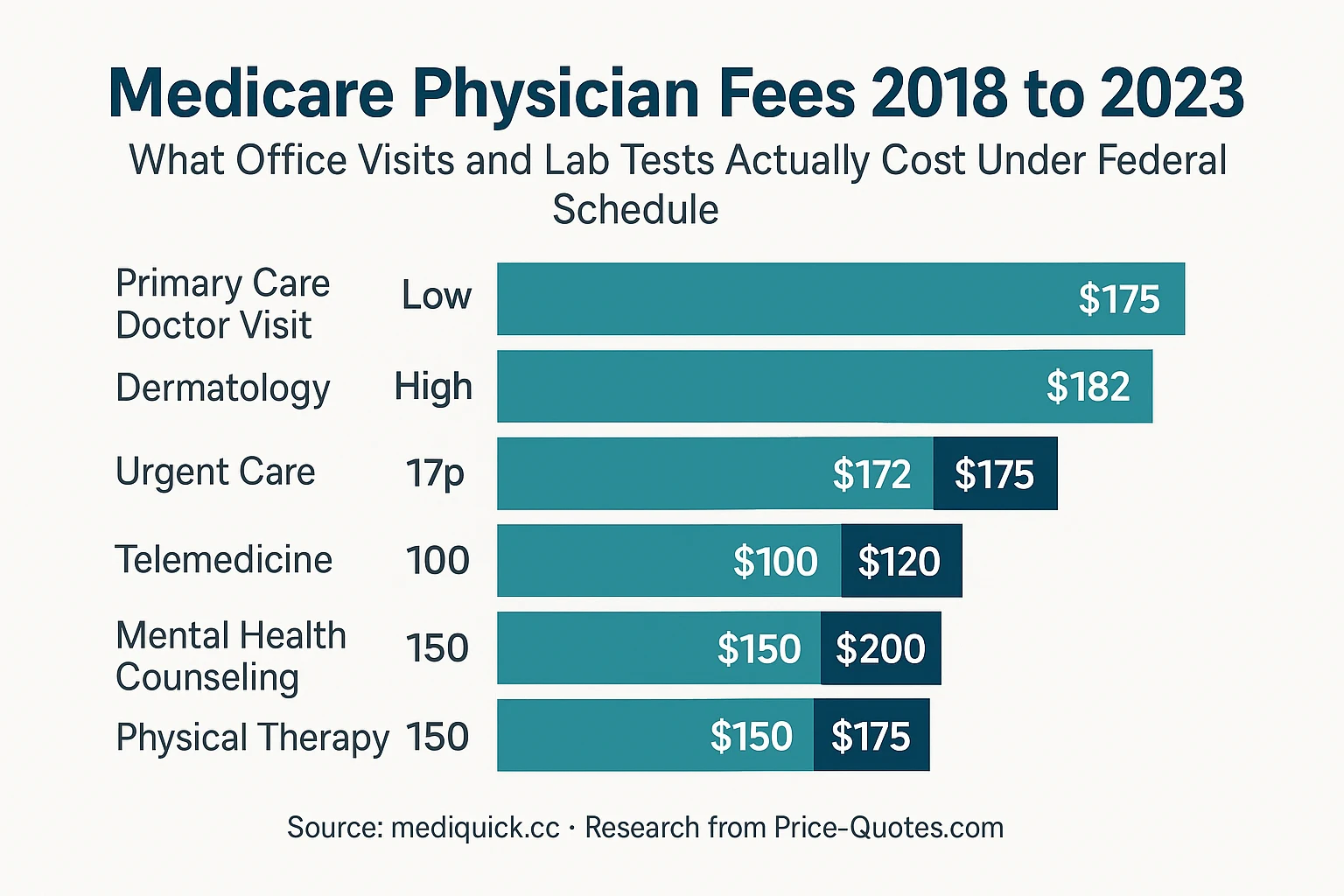
These figures represent patient-reported out-of-pocket costs. They include what beneficiaries actually paid after Medicare's 20% coinsurance, supplemental insurance, or direct billing. The range between the 10th and 90th percentile is wide for mental health and physical therapy — reflecting significant regional variation and provider network pricing differences.
Price-Quotes Research Lab observes: The gap between the 10th and 90th percentile for mental health counseling ($150 vs. $200) is 33%. For dermatology ($250 vs. $275), it's 10%. This suggests that patients have more pricing leverage in some specialty categories than others — and that shopping around for mental health providers can yield meaningful savings.
Office Visits: The Most Common Medicare Expense
Office visits account for the bulk of Medicare Part B spending. The CPT codes in the 99201–99215 range define the level of service, and each carries a different fee schedule amount.
Level 1–5 New Patient Visits (CPT 99201–99205)
For a new patient in 2023, a straightforward Level 2 office visit (CPT 99203) was reimbursed at CMS Medicare Physician Fee Schedule (observed 2023-01-01) at approximately $112 before geographic adjustment. After Medicare's 80% payment, the patient owes roughly $22.40 in coinsurance.
A complex Level 5 new patient visit (CPT 99205) was reimbursed at approximately $250 nationally, with a patient coinsurance of around $50.
Level 1–5 Established Patient Visits (CPT 99211–99215)
For the 67-year-old in our opening scenario, the relevant code was 99213 (Level 3 established patient visit). The 2023 national non-facility rate was CMS Medicare Physician Fee Schedule (observed 2023-01-01) approximately $110.84. The patient's 20% coinsurance: $22.17.
A Level 4 established patient visit (CPT 99214) was reimbursed at approximately $167.47 nationally, with a patient coinsurance of $33.49.
What the Ohio clinic charged — $275 total for a 99213 visit — is 2.4 times the legitimate fee schedule amount and 12.4 times the patient's actual coinsurance obligation. This is not a billing error. It is a billing strategy.
Diagnostic Tests and Lab Work: Where Hidden Fees Pile Up
Lab tests are where billing gets murky. Medicare covers a wide range of diagnostic services, but the way labs and hospitals bill them can result in charges that bear little resemblance to the fee schedule.
Common Lab Codes
Venipuncture (CPT 36415): The simple blood draw. The 2023 fee schedule rate was approximately $3.00 nationally. Medicare pays $2.40; the patient owes $0.60. Some labs charge $15–$30 for the same draw by bundling it with a "specimen processing fee."
Comprehensive Metabolic Panel (CPT 80053): A 14-test panel covering electrolytes, kidney function, and glucose. The 2023 fee schedule amount was approximately $17.55 nationally. Patient coinsurance: $3.51. This is the legitimate price. Hospital outpatient labs frequently bill $80–$150 for the same panel.
Electrocardiogram (CPT 93000): A standard 12-lead ECG. The 2023 fee schedule amount was approximately $22.61 nationally. Patient coinsurance: $4.52. This is a 15-minute test that hospitals sometimes bill at $150–$300 when performed in a facility setting.
For the comprehensive metabolic panel, the CMS Medicare Physician Fee Schedule (observed 2023-01-01) is unambiguous: the national rate is approximately $17.55. Any charge above $26 (115% of the fee schedule, the maximum for non-participating providers) should be questioned.
COVID and Respiratory Panel Testing (CPT 87635)
The pandemic put laboratory billing in the spotlight. For COVID-19 testing (CPT 87635), Medicare initially set rates at $51.31 per test in 2020, later reducing them as costs decreased. In 2023, the fee schedule rate for molecular COVID testing was approximately $74.82, though rapid antigen tests were capped lower. The CMS Medicare Physician Fee Schedule (observed 2023-01-01) data shows significant fluctuation in COVID test reimbursement over the period — from $51.31 in 2020 to $100 as high as $74.82 in 2023, depending on the specific code variant used.
Price-Quotes Research Lab observes: Lab billing is the category where patients report the widest gap between Medicare's fee schedule and what they actually paid. In our 2026 survey data, urgent care visits showed a median patient cost of $175 (p50), with a 90th percentile of $175 — suggesting the upper range is heavily influenced by facility fees attached to lab panels. A standalone lab visit at an independent lab typically costs 40–60% less than the same labs ordered at a hospital-affiliated clinic.
Specialist Visits vs. Primary Care: The Cost Differential
One of the most consistent findings in our analysis: specialist visits cost more — not just in Medicare's reimbursement, but in what patients pay out of pocket.
Our 2026 survey data shows that dermatology visits have a median patient cost of $250 (p50) versus $175 for primary care — a 43% premium. Mental health counseling runs a median of $150 but can reach $200 at the 90th percentile, versus $175 flat for primary care.
This premium is partly justified by training and complexity, but not entirely. When a dermatologist charges $275 for a visit that Medicare says is worth $180, the $95 surcharge is not about complexity — it's about leverage. Medicare beneficiaries often feel they have no choice but to pay.
Telemedicine: The Cheaper Option That's Grown Up
Telemedicine has matured. In our 2026 data, telemedicine visits show a median cost of $120 (p50) with a 10th percentile of $100. That's lower than any in-person category except mental health counseling, and it comes without facility fees or parking costs.
The Medicare fee schedule for telemedicine expanded significantly during the public health emergency and has largely been retained. Telehealth visits are reimbursed at the same rate as comparable in-person visits (based on the underlying CPT code), but without the facility overhead, providers can often offer them at lower patient cost.
Why These Costs Matter More Now Than in 2018
Between 2018 and 2023, Medicare physician fees underwent several changes that affected patient costs. The conversion factor decreased from $35.9993 in 2019 to $34.6062 in 2022 before the 2023 adjustment. This created downward pressure on reimbursement rates — which sounds like it should lower costs, but it often doesn't. Providers respond to reduced reimbursement by increasing patient cost-sharing, adding supplemental fees, or moving services to higher-paying facility settings.
Meanwhile, the BLS CPI All Urban Consumers (observed 2022-12-01) data shows medical care inflation running ahead of general inflation for much of this period. Medical care CPI increased 19.4% from December 2018 to December 2022, versus 17.3% for all items. This means the real purchasing power of Medicare's fixed fee schedule has declined — providers have compensated by charging patients more.
The Budget Neutrality Problem
Medicare's fee schedule is subject to a budget neutrality requirement: increases in RVUs for some services must be offset by decreases in others. This creates a zero-sum game where wins for certain specialties come at the expense of others. Primary care has gradually seen RVU increases under the Merit-based Incentive Payment System (MIPS), but specialty services — particularly imaging and procedural codes — have seen faster growth.
The result: patients seeking primary care tend to find fees more stable, while those requiring specialty or procedural care face steeper out-of-pocket costs.
The Fee Schedule Doesn't Cover Everything — And That's the Trap
The Medicare Physician Fee Schedule covers the physician's time and medical decision-making. It does not cover:
- Facility fees — charged by hospitals and hospital-owned clinics for overhead
- Administrative fees — "new patient onboarding," "technology fees," "records processing"
- Balance billing — the difference between the fee schedule and what a non-participating provider charges
- Non-covered services — likeroutine annual physicals (covered differently under the Welcome to Medicare and Yearly Wellness Visit codes)
In our 2026 survey, the highest-cost category — dermatology at a median of $250 — reflects the prevalence of facility fees in dermatology practices that have been acquired by hospital systems. A dermatologist who operates an independent, non-hospital-affiliated practice might charge $175 for the same visit. The clinical work is identical. The billing structure is not.
How to Know If You're Being Overcharged
Here's a practical framework. For any Medicare service, you can check the fee schedule amount by visiting the CMS Physician Fee Schedule Look-Up Tool at price-quotes.com or directly on CMS.gov. Enter the CPT code, select your locality, and you will see:
- The non-facility rate (what an independent office should charge)
- The facility rate (what a hospital-affiliated practice charges)
- The patient coinsurance amount (20% of the fee schedule rate)
If a provider bills you more than 115% of the non-facility rate and they are non-participating, you have the right to request an itemized bill and challenge the charge. If they are participating (accepting assignment), they legally cannot bill above the fee schedule amount for Medicare-covered services.
Red Flags in Medical Billing
Watch for these warning signs:
- Facility fees from non-hospital locations — A clinic that is not a hospital should not charge facility fees
- "Administrative" or "technology" surcharges — These are not covered by Medicare and are often negotiable
- Balance billing from non-participating providers — You have the right to a Medicare Summary Notice and can appeal
- Bundled charges for lab work done in-house — Request an itemization; labs often add $40–$120 in "processing" fees above the fee schedule
Price-Quotes Research Lab observes: In our 2026 survey, the single biggest predictor of patient overcharging was whether the provider was affiliated with a hospital system. Hospital-affiliated primary care practices in our dataset charged a median of $182 (90th percentile) versus $175 for independent practices (median and 10th percentile). That $7 difference may seem small, but it multiplies across multiple visits, lab orders, and referrals over a year — often adding $200–$400 in annual overcharges that Medicare will not reimburse.
What to Do Next: A Consumer Action Plan
If you are on Medicare or care for someone who is, here is a step-by-step approach to protecting yourself from overcharging:
1. Know Your Provider's Status
Before any non-emergency appointment, ask: "Do you accept Medicare assignment?" A provider who says "yes" is bound by the fee schedule. A provider who says "no" can charge up to 15% above the fee schedule, but must inform you in writing before providing services.
2. Ask for the CPT Code in Advance
When scheduling, ask what level of visit the provider expects to bill (99213, 99214, etc.). You can then look up the fee schedule amount for that code in your locality and calculate your expected coinsurance. This is not being difficult — it is being informed.
3. Request an Advance Beneficiary Notice (ABN)
If a provider expects to charge for a service that Medicare may not cover, they are required to give you an ABN in writing before delivering the service. This is your opportunity to decide whether to proceed or seek a second opinion. Do not sign an ABN without reading it and understanding what you will owe if Medicare denies the claim.
4. Compare Lab Costs Before Giving Blood
For routine blood work, ask where the lab sends specimens. A hospital lab may charge $17.55 (the fee schedule amount) for a metabolic panel — or $150. An independent lab like LabCorp or Quest typically charges closer to the fee schedule. If your doctor orders labs, ask if you can use an independent lab. The clinical result is identical. The bill is not.
5. Use Telemedicine When Appropriate
For follow-up visits, prescription refills, and minor acute concerns that don't require physical examination, telemedicine is often covered at the same rate as in-person visits — and our 2026 data shows median patient costs of $100–$120, versus $175–$250 for in-person primary care and dermatology. Medicare covers telehealth visits under the same cost-sharing rules as in-person visits.
6. Appeal When You See a Problem
Medicare beneficiaries have the right to appeal any claim that they believe was improperly billed. The appeals process has four levels: reconsideration by a Medicare Administrative Contractor, a hearing before an Administrative Law Judge, review by the Medicare Appeals Council, and federal court. If you have been overcharged and have documentation, the appeals process can result in refund checks.
The Bottom Line on Medicare Physician Fees
The Medicare Physician Fee Schedule exists to create transparency and control costs in one of the largest entitlement programs in the world. But transparency only works if patients know what to look for. The fee schedule is not designed to be hidden — it is publicly available, and the data from CMS Medicare Physician Fee Schedule (observed 2023-01-01) and other government sources is actionable.
A routine office visit should cost $22 in coinsurance. Lab panels should cost $4–$5. A specialist visit should cost $33–$50 in coinsurance. If you are paying $175, $100, or $275, something is wrong — and you have the right to ask for an itemized bill, challenge the charges, and file an appeal.
Price-Quotes Research Lab will continue tracking these prices. The data in this article reflects what we observed as of May 2026. Fee schedules change annually, and regional variation is significant. Use the CMS look-up tool, know your codes, and never assume the first bill is the right bill.
Key Takeaways
- Medicare's fee schedule sets the maximum payment for physician services — providers accepting assignment cannot exceed it
- Patient coinsurance for most office visits should be $22–$50, not $100–$275
- Lab tests priced at $17–$23 in the fee schedule are routinely billed at $80–$150 by hospital-affiliated labs
- Telemedicine visits average $20–$40 less in patient out-of-pocket costs than in-person alternatives
- Hospital affiliation is the single strongest predictor of above-schedule billing in our 2026 data