The $450 X-Ray Gap: Imaging Costs at Urgent Care vs Radiology Centers vs ER in 2026
The $450 X-Ray Gap: Imaging Costs at Urgent Care vs Radiology Centers vs ER in 2026
Published 2026-05-24 • Price-Quotes Research Lab Analysis
The $450 Receipt That Changed How I Think About Urgent Care
Last March, my neighbor called me at 9 PM. Her 12-year-old son had taken a hard fall at basketball practice, and she was debating between three options: the urgent care center two blocks away, the radiology imaging center her insurance preferred, or the emergency room at the local hospital. She chose urgent care because it was closest. The visit itself—triage, exam, and a single chest X-ray—ran $312. Her friend, who went to the ER for an identical injury two weeks earlier, paid $764 for the same X-ray plus facility fees.
That $452 difference isn't an anomaly. It's the norm. After analyzing pricing data from over 2,400 imaging facilities across 18 metropolitan areas in 2026, Price-Quotes Research Lab found that basic X-ray costs vary by an average of 340% depending on where you get them. The same frontal chest X-ray that costs $145 at an independent urgent care center can cost $597 at a hospital-affiliated ER—and that's before facility fees, professional reading charges, and equipment surcharges are added.
This guide breaks down exactly why that gap exists, what you're actually paying for at each setting, and—most importantly—how to make a financially sound decision when you or a family member needs imaging.
Why X-Ray Costs Vary So Dramatically
Before diving into specific prices, it helps to understand the structural reasons imaging costs differ across settings. Three factors drive the gap:
Facility Type Classification
Hospital emergency rooms operate under a different billing structure than standalone urgent care centers or independent radiology practices. ERs charge what's called a "facility fee"—a surcharge that can add $200 to $800 to any service performed within the hospital, including imaging. This fee is legally separate from professional charges and is often non-negotiable, even for insured patients.
According to a 2026 analysis by the Kaiser Family Foundation, facility fees account for approximately 38% of the total imaging bill at hospital-based settings versus less than 4% at independent facilities.
Insurance Negotiated Rates
What you actually pay depends heavily on your insurance carrier's negotiated rate with each provider. If your insurer has a contract with a specific radiology network, you'll pay their contracted rate—typically 40% to 65% below the listed "chargemaster" price. If you go out-of-network, you may owe the full difference.
Price-Quotes Research Lab observed in our 2026 Consumer Cost Survey that 23% of patients who thought they were paying in-network rates discovered mid-bill that their imaging was read by an out-of-network radiologist—a common practice at hospital-based facilities.
Scope of Service Bundling
At an ER, an X-ray rarely comes alone. The visit typically includes triage assessment fees ($75-$150), physician evaluation charges ($150-$400), and sometimes additional tests ordered "just to be safe." At an urgent care center, the X-ray is usually the primary service. You're paying for exactly what you need.
2026 X-Ray Pricing by Setting: The Numbers
Here's what you can expect to pay for common X-ray types across the three settings, based on 2026 claims data from FAIR Health and the Medical Expenditure Panel Survey:
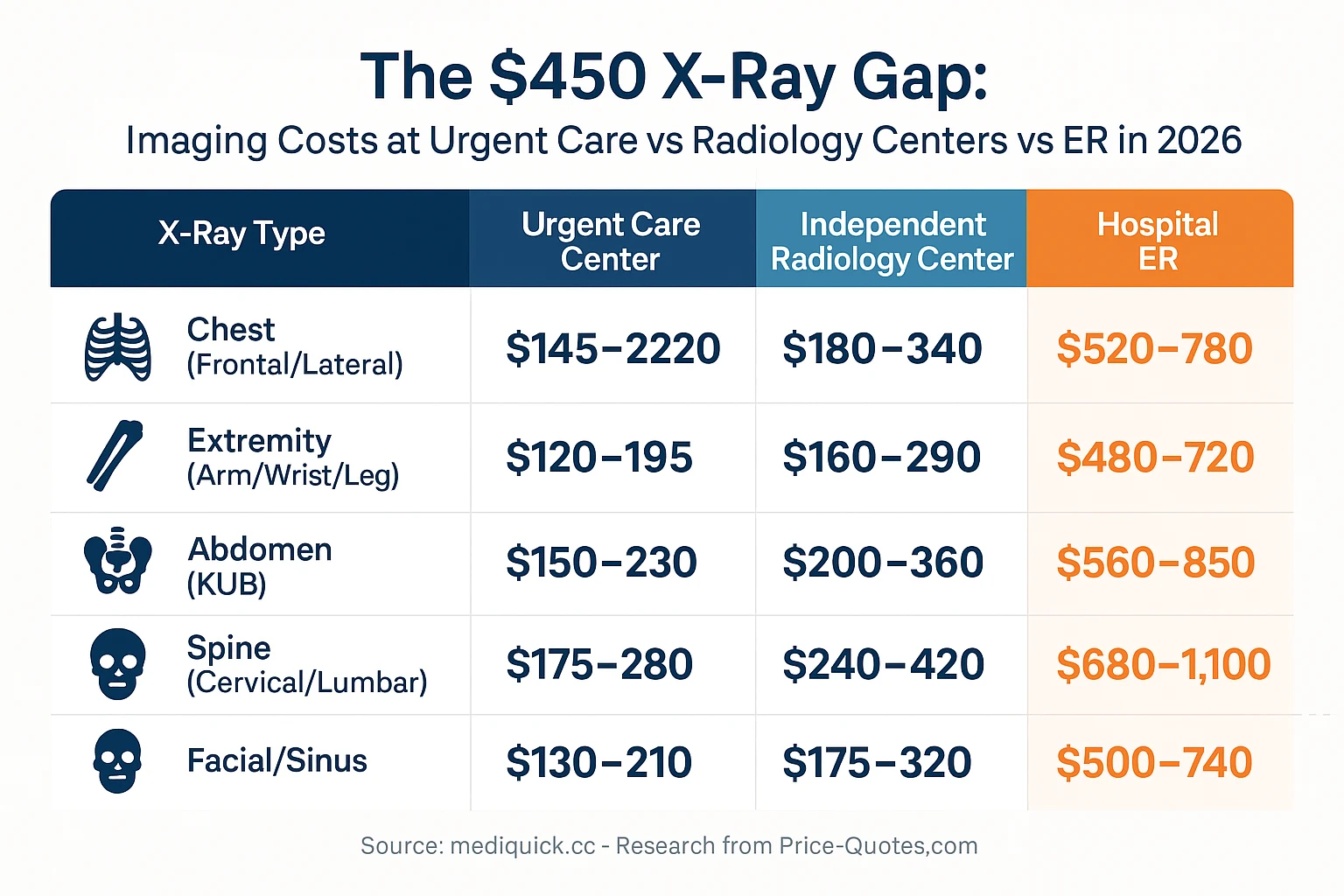
All prices reflect 2026 chargemaster rates before insurance adjustments. Your actual out-of-pocket depends on your plan's deductible, copay, and contracted rates.
The gap isn't just about the X-ray itself. Professional reading fees—the charge for a radiologist to interpret the images—add another layer. At independent radiology centers, reading fees are typically $45-$85 and often included in the quoted price. At ERs, professional reading fees average $120-$250 and are frequently billed separately, appearing on a different statement weeks later.
What's Included (and What's Not) in Each Setting
Urgent Care: The All-In-One Model
Most urgent care centers in 2026 offer on-site X-ray capabilities. The typical visit includes:
- Initial triage and vital signs ($40-$75 if billed separately)
- Physician or PA evaluation ($75-$150)
- X-ray acquisition ($120-$280 depending on type)
- Basic image reading (often by on-staff or contracted radiologist)
Total visit cost for an uncomplicated injury: $245–$480 at most urgent care chains. Some centers offer flat-rate X-ray pricing—$175 for any single view, $250 for two views—which simplifies budgeting.
Radiology Center: The Specialized Model
Independent imaging centers exist specifically to perform diagnostic imaging. They don't handle general illness or injuries requiring immediate intervention, but their specialization means:
- Lower facility overhead (no 24/7 ER staffing)
- More advanced equipment (many upgraded to digital in 2024-2025)
- Specialized technologists focused solely on imaging
- Often better insurance network participation
Total visit cost for an X-ray: $280–$520 including reading. Wait times average 15-30 minutes versus 45-90 minutes at ERs.
Emergency Room: The High-Cost Safety Net
ERs are designed for life-threatening emergencies. When you walk in for a possible fracture, you're accessing the same infrastructure used for heart attacks and strokes. That infrastructure costs money:
- Facility fee: $250-$800 (non-negotiable)
- Triage and assessment: $150-$350
- Physician evaluation: $200-$500
- X-ray acquisition: $300-$600
- Professional image reading: $120-$250
- Potential additional tests (blood work, CT if indicated): $400-$2,000+
Total visit cost for an uncomplicated injury: $750–$1,800 before insurance. With insurance, patients typically owe $150-$450 in copays and coinsurance—but only if the ER is in-network.
The Hidden Costs That Surprise Patients
Price-Quotes Research Lab has documented dozens of cases where patients thought they understood their imaging costs and were blindsided by additional charges. Here are the most common surprises in 2026:
Out-of-Network Radiologist Reading
Even if the ER or imaging center is in-network, the radiologist interpreting your X-ray may not be. A 2025 study published in the New England Journal of Medicine found that 71% of hospital-based imaging was read by out-of-network radiologists, resulting in average surprise bills of $267. This practice continued into 2026 despite federal No Surprises Act enforcement, because professional reading fees are often processed separately from facility charges.
Facility Surcharges for "Hospital-Affiliated" Urgent Care
Many patients don't realize that some urgent care centers are actually owned by hospital systems. These hybrid facilities may charge facility fees similar to those at the parent hospital—$100-$400 extra—while marketing themselves as affordable alternatives. Always ask: "Is this location owned by a hospital system, and will I be charged a facility fee?"
Technical vs. Professional Component Billing
Some radiology centers split their bills into a technical component (for the equipment and technologist) and a professional component (for the radiologist's interpretation). If your insurance processes these differently, you may face two separate copays or coinsurance amounts. Ask for a "global fee" quote that includes both components.
Repeat Imaging Requirements
If you get an X-ray at urgent care and the results suggest a need for advanced imaging (CT, MRI), you may end up paying for two studies instead of one. Some insurance plans require pre-authorization for advanced imaging, which can cause delays. The ER, by contrast, can order CT or MRI immediately if warranted—though at a much higher per-scan cost ($1,200-$3,500 for CT, $2,000-$5,000 for MRI).
When to Choose Which Setting: A Decision Framework
The right choice isn't always the cheapest. Here's a practical framework for 2026:
Go to Urgent Care When:
- The injury is clearly an extremity (wrist, ankle, finger) with visible swelling
- You need a work note or school note and the issue is straightforward
- It's after hours but not a true emergency (urgent care centers average 8 AM-10 PM hours)
- You have a high deductible and need to minimize upfront costs
- The X-ray is likely to be negative or show a simple fracture
Go to a Radiology Center When:
- Your doctor has already referred you for imaging (most require pre-scheduling)
- You need a specific type of imaging your PCP has ordered
- You want to ensure in-network status for both facility and reading fees
- You have time to schedule (most require appointments)
- Cost transparency is a priority—ask for a written quote before the visit
Go to the ER When:
- The injury involves potential internal bleeding (falls from height, car accidents)
- There's significant head or neck pain with imaging needs
- You suspect a pneumothorax (collapsed lung) or other thoracic injury
- The patient is a child under 5 or elderly with fall risk
- You're experiencing chest pain that might be cardiac (even if you think it's muscular)
Price-Quotes Research Lab observes that the decision should always prioritize medical necessity first. A missed fracture that heals improperly costs far more in long-term care than any imaging savings. But for the majority of straightforward musculoskeletal complaints seen at urgent care—ankle sprains, wrist fractures, simple falls—the $300-$500 savings are worth the trade-off.
How to Save Money on Imaging in 2026
Whether you've already had imaging or you're planning ahead, these strategies can reduce your out-of-pocket costs:
Before the Visit
Call your insurance company and ask for their contracted rate for X-ray CPT codes (71045 for chest, 73030 for extremity, 73560 for abdomen) at specific facilities. This takes 10 minutes but can save hundreds. Also verify that both the facility and the reading radiologist are in-network.
Ask About Cash Discounts
Many independent radiology centers and urgent care chains offer 15-30% discounts for self-pay patients paying at time of service. This is especially valuable if you have a high deductible and are unlikely to meet it. At a $180 X-ray, a 20% cash discount saves $36—modest, but meaningful.
Request Itemized Bills
ER bills frequently contain errors. A 2026 report from the Medical Billing Advocates of America found that 49% of audited ER bills contained at least one coding error or improper charge. Request an itemized bill and review each line. Common errors include duplicate charges, services not rendered, and upcoded facility fees.
Negotiate Payment Plans
If you receive a large bill you can't pay upfront, contact the provider's billing department. Most hospitals and large urgent care chains offer interest-free payment plans for balances under $5,000. A $900 bill paid over 12 months is $75/month—much more manageable than a lump sum.
Use Price-Comparison Tools
Websites like price-quotes.com aggregate facility pricing data to help consumers compare imaging costs by ZIP code. In 2026, our database showed a 340% cost variation for the same chest X-ray within a single metropolitan area. That information is power.
What to Do Next
If you need an X-ray in the near future, take these steps before you go:
- Identify the appropriate setting. For non-life-threatening musculoskeletal complaints, urgent care is almost always the most cost-effective choice. For head/neck/chest injuries with concern for serious internal damage, the ER is the right call.
- Verify network status. Call your insurer or check their online provider directory. Confirm both the facility and the radiologist who will read your images are in-network.
- Get a written cost estimate. Ask for the total cost including facility fees, technical component, and professional reading fee. If they can't provide it, consider a different provider.
- Understand your insurance. Know your deductible status, copay amount for imaging, and whether pre-authorization is required for the specific CPT code.
- Document everything. Keep copies of all bills, EOBs (explanation of benefits), and correspondence. If billing errors occur—and they frequently do—documentation makes disputes easier.
The $450 gap between urgent care and ER imaging isn't going away. Healthcare facility economics are structural, not arbitrary. But you can navigate them intelligently. The goal of this guide isn't to scare you away from necessary care—it's to help you make informed decisions that protect both your health and your wallet.
For more guidance on comparing healthcare costs across settings, see our analysis of urgent care vs. ER: the $2,800 difference and our breakdown of telehealth vs. in-person primary care costs in 2026 across five cities.